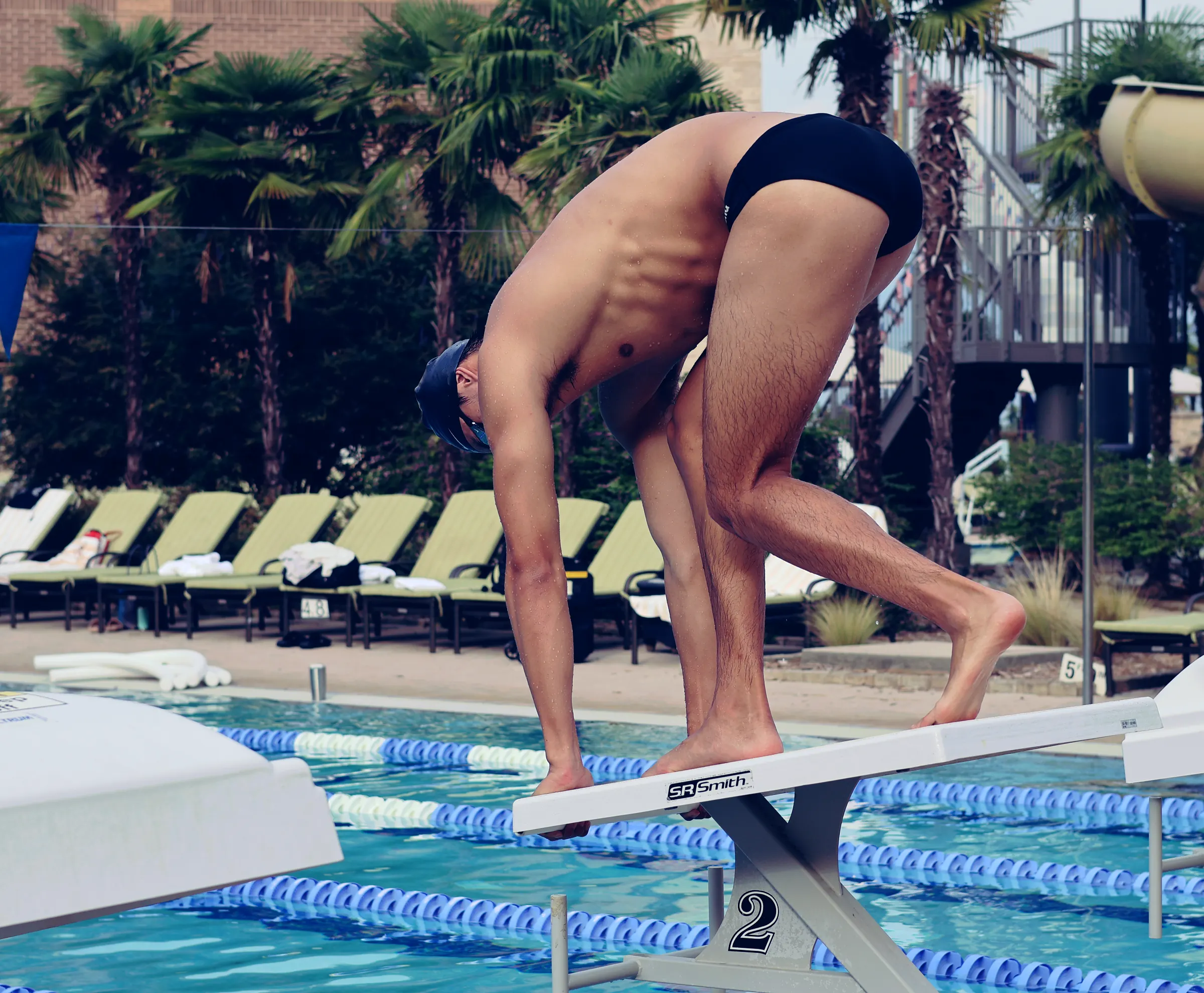
Your start, measured.
You upload your start. SwimVolt tracks it frame by frame and shows you exactly what to work on.
01 — How it works
Three steps, about a minute.
A phone on the pool deck is the whole setup. Prop it on a kickboard or hand it to a teammate, and film one dive.
Step 1: Film one dive
Scroll on to watch step 2 happen02 — See it in action
Scroll the dive.
Watch it get measured.
03 — What we measure
49 measurements, one dive.
Three from each phase, read off one real dive.
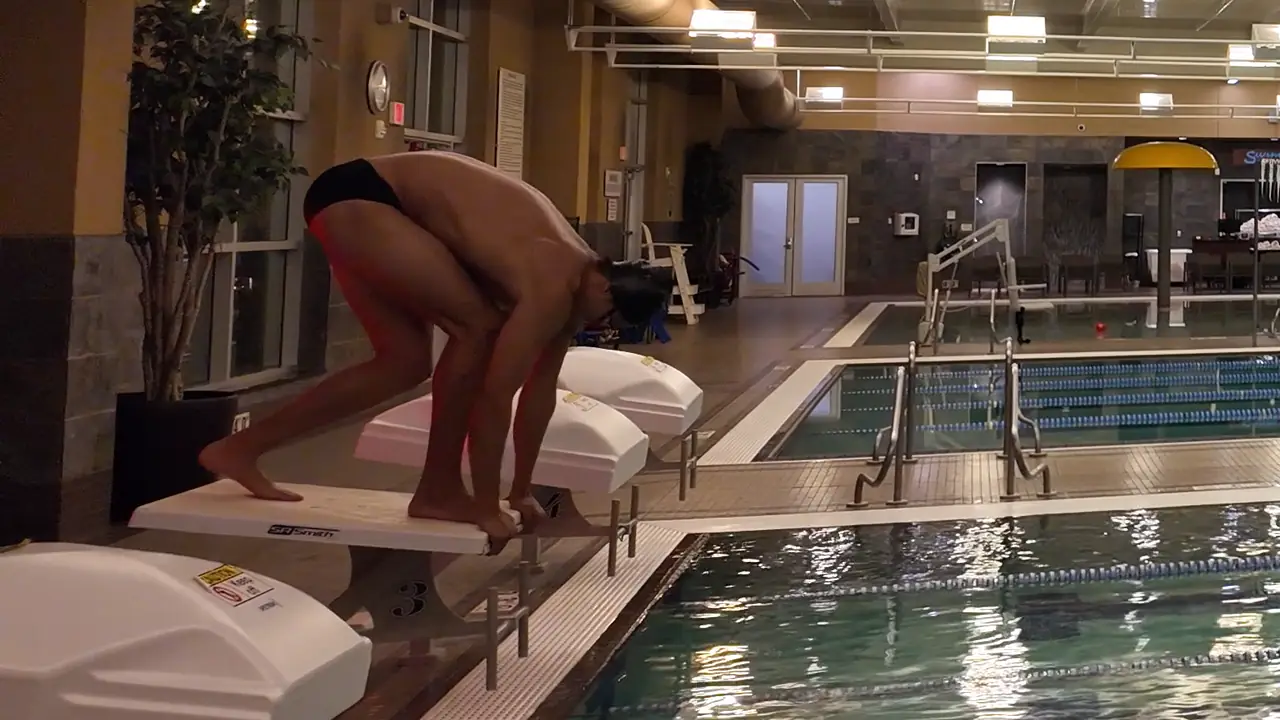
Back heel · setup
34°
How high your back heel is off the block at the set position.
Back heel: 34° setup. How high your back heel is off the block at the set position.
04 — The literature
The work behind the numbers.
Targets come from published swimming biomechanics, from coaches, or from our own estimate. Each one says which it is.
- 2021Matúš et al.Int. Journal of Environmental Research and Public Health
Where the front-knee range at your set position comes from. We raised its ceiling to 160° after every swimmer we checked measured above it.
18 male competitive swimmers, 50 m freestyle 23.3 s
- 2020van Dijk et al.PLoS ONE
Where the 32–44° entry angle comes from. Your hands and your legs are checked against it separately.
14 sub-elite and elite swimmers, 349 starts
- 2026Born et al.Bioengineering
What your take-off speed is compared against. Everyone in it is national-team level, so it shows where your number sits instead of grading it.
136 national-team swimmers, including Olympic medallists and a world-record holder
All 10 sources, and what we still estimate.
The coaching rules came from coaches and biomechanists, and from swimming the event ourselves. We refilmed the same starts to check ourselves and published what we found.
05 — Behind the software
Built by a swimmer.

Christopher Zhang
Founder
Christopher Zhang is a current D1 swimmer at Brown University.
“Starts are one of the hardest things in swimming to learn. I wanted to build software for a problem I actually had, and make starts easier for everyone.”
06 — Re-analyze & track change
Film it again next week.
SwimVolt counts how many times you repeat the same fault. Every dive stays in your log with its pose replay.
Start your dive logYour repeating fault
You missed your hand pull-back in 4 of your last 5 dives.
Pricing
Two analyses a month, free, at full depth. Go unlimited when you want more.
Free
Try it on a few dives
- 2 analyses every month, at full depth
- Saved history with pose-overlay replays
- Your footage stays yours. Delete it anytime.
Athlete
Analyze every dive you film
billed $79 / year
- Unlimited analyses
- Everything in Free
- Cancel anytime
Coaches
For clubs and school programs
- The same start analysis your swimmers use today
- Club tools (rosters, comparison, batch) are not in the app yet
No dashboards to buy. If you coach a squad, tell us what you need and we'll say honestly what's next.
Questions, answered
What do I need to film?
One clip, 10 seconds or less, landscape, filmed from the side of the pool so the whole dive is visible. Any phone works, and you don't need a tripod. SwimVolt checks how much the camera shook and flags the clip if it moved too much to trust.
How accurate is the tracking?
Pretty accurate, and tuned for swimming starts specifically. We marked the frame the feet leave the block by hand on real dives, then worked on the detector until it agreed within about a frame. It is early, so if a number looks wrong, tell us and we will look at your clip.
Does AI make up the numbers?
No. There is no AI in the analysis. Every number and every line of feedback comes from tracking your video frame by frame, so the same clip always gives you the same answer.
Won't the same dive measure differently from a different angle?
Less than you would think. We filmed the same dives from many angles. Trunk angles and timings barely moved, and entry angle was among the steadiest. Knee, hip and head angles move more, because your near limb hides the far one. Stand beside the block if you can.
Where do the target ranges come from?
Three places: published swimming research, coaches, or our own estimate. Most come from coaches. Every target says which of the three it is, in the app and on the research page.
What happens to my footage?
It is saved to your account, so you can rewatch your dives with the skeleton drawn on top. If you delete a dive, or your whole account, the video is really deleted from storage.
Does it work for strokes?
Not yet. SwimVolt only measures the dive start: setup, launch, flight and entry. Strokes may come later.